
The Four Points Framework
A marketing framework to help you think clearly.


There's a particular madness that overtakes you in a boardroom at 2 AM, surrounded by empty coffee cups and the fading smell of takeout. The walls are plastered with sticky notes, and someone's drawn another 2x2 matrix that's supposed to solve everything. This is the natural habitat of the framework junkie.
I've been that person.
But after years of watching strategists chase frameworks like addicts chasing a high, I've developed a certain fondness for the Four Points. Not because it's perfect—nothing is—but because it acknowledges something most frameworks don't: that strategy isn't just about organizing information. It's about organizing thinking.
The Framework Addiction
I was introduced to this framework while on a short stint with Nike. The creative director I was working with loved it, and he wouldn’t stop talking about it. At the time, I was skeptical; frameworks promise order from chaos, clarity from confusion. They seduce us with their clean lines and confident assertions. "Let me tear down the world as you know it and build it anew within this framework," they whisper. And we listen, because the alternative is admitting we don't know what we're doing.
I've watched too many smart people use frameworks as self-playing pianos. Press the keys, and out comes the melody, no actual musicianship required. But this one was different, The Four Points doesn't do the thinking for you—it forces you to actually think.
What Makes The Four Points Different
The Four Points framework stands on... well, four points:
Problem: Not just any problem, but the human problem behind the business problem.
Insight: An unspoken human truth that sheds new light on the problem.
Advantage: What makes your thing unique and motivating in people's minds.
Strategy: A new way of seeing your thing based on all of that.
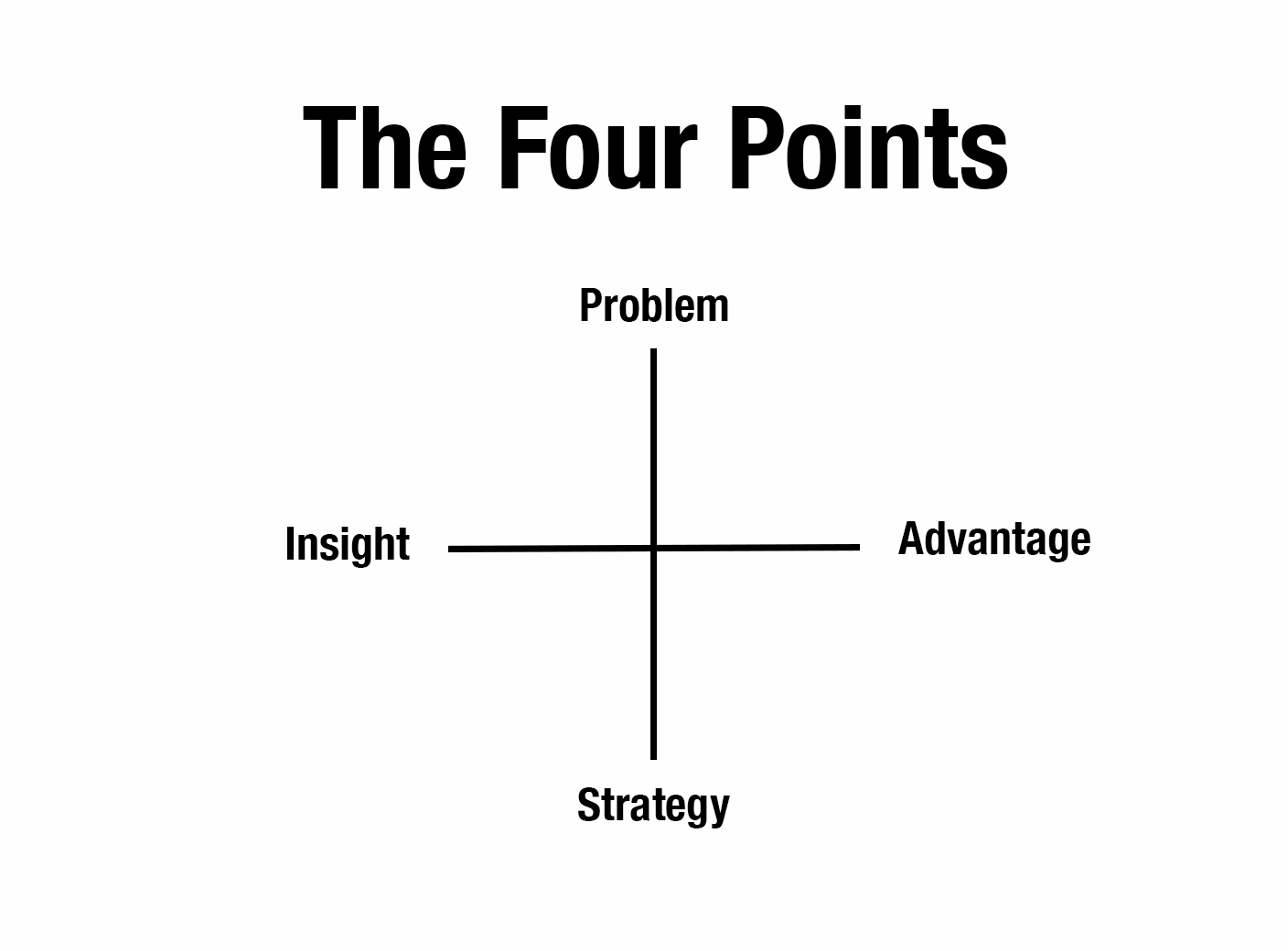
Unlike frameworks that promise turnkey solutions, the Four Points just organizes the hard parts of strategic thinking in a sequence that builds energy. Each point needs to connect to the same theme. Each needs to emit from the same source.
For example, you could use this with a client who makes luxury kitchen appliances. Their business problem was clear: declining sales in a market where cheap alternatives were improving. But the human problem? People who bought luxury items weren't getting the emotional payoff they expected. The insight wasn't about product features but about the disappointment of owning something expensive that nobody notices or appreciates.
The Four Points framework forced us to dig deeper than "we need better features" or "we need stronger brand positioning." It made us confront the emotional reality of luxury purchases. The resulting strategy wasn't just about highlighting quality or heritage; it was about making ownership visible and satisfying in ways competitors couldn't match.
The New York Knicks Example: Brilliantly Absurd
A bit after meeting that creative director, I read a book by Mark Pollard—can’t remember the title—but one example stuck with me: he used the 4 Points framework to help the Knicks rethink their strategy. I’ve never forgotten it.
The problem: "Fans are hate-supporting the team."
The insight: "The ultimate New York trait is to put up with everything until you snap."
The advantage: "The Knicks are designed to make people angry."
The strategy: "The New York Knicks are the best anger management in town."
They based an entire campaign on the Knicks being anger management. Very New York.
It's absurd. It's also weirdly compelling because it hangs together around a single theme—anger—and builds energy as it goes. There's a thread that connects each point to the next. That's what makes a strategy feel inevitable rather than forced.
Why Thinking Matters More Than Frameworks
The Four Points tries to solve five things:
A lack of thinking
Disconnected thinking
A disdain for process
Disenfranchisement in strategy jobs
The confusion of early-career strategists
That fifth one hits home. I remember being a young person drowning in frameworks, feeling like I needed to master each one before I could contribute anything valuable. But here's the truth: a framework isn't meant to be a formula. It's meant to be a scaffold for your own thought. A framework should make your thinking better, not replace it.
How I Use The Four Points
By limiting myself to just these four elements—problem, insight, advantage, strategy—I'm forced to distill my thinking to its essence. I can't hide behind a 50-slide deck of analysis. I can't substitute research for clarity.
The beauty of this framework isn't in its complexity or comprehensiveness. It's in its simplicity and focus. It asks only that you think clearly about four things—but they're the four things that matter most.
In Defense of Frameworks (Sort Of)
I've been hard on frameworks here, but the truth is, they exist for a reason. Thinking is hard. Thinking together is harder. Frameworks give us a common language and structure.
The Four Points accepts this idea. It just tries to be a better kind of framework—one that serves thinking rather than replacing it.
In a world addicted to certainty, the Four Points embraces the messy reality of strategic thinking. It doesn't promise clear answers. It promises a clearer path to finding your own answers.
And in a profession drowning in frameworks, that's something worth holding onto.